
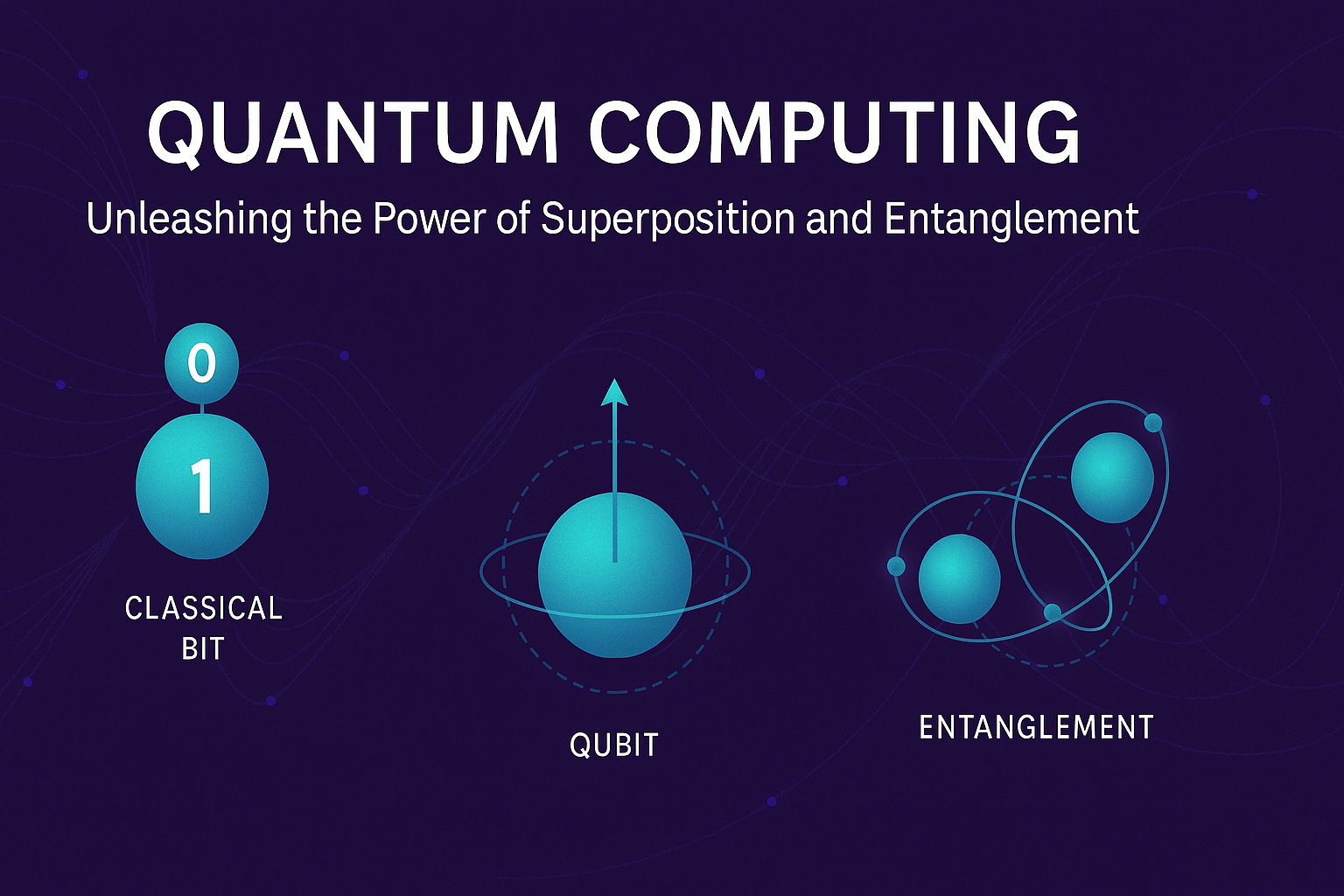
In the realm of technology and computation, quantum computing represents a leap into the future, promising capabilities far beyond what classical computing can achieve. At the heart of this revolutionary technology lie two fundamental principles of quantum mechanics: superposition and entanglement. These phenomena not only challenge our classical understanding of physics but also enable the extraordinary processing power of quantum computers.
The Quantum Leap: Superposition in Computing
Quantum superposition is a principle where particles, such as electrons or photons, exist in multiple states simultaneously. This contrasts starkly with the binary state of classical bits, which can only be 0 or 1 at any given time. Quantum bits, or qubits, leverage superposition to represent both 0 and 1 together, allowing quantum computers to perform multiple calculations at once. This parallel processing capability is what gives quantum computers their potential to solve complex problems that are currently intractable for classical computers.
The double-slit experiment, a cornerstone of quantum mechanics, vividly demonstrates superposition. When particles are fired at a barrier with two slits, they create an interference pattern on a detector screen, as if each particle passes through both slits simultaneously and interferes with itself. This experiment conclusively shows that particles can indeed be in multiple places at once, laying the groundwork for utilizing superposition in quantum computing.
Entangled Across Space: The Phenomenon of Quantum Entanglement
Quantum entanglement, another pillar of quantum computing, occurs when particles become interconnected in such a way that the state of one instantly influences the state of another, regardless of the distance between them. This phenomenon, which Einstein famously described as “spooky action at a distance,” allows qubits in a quantum computer to be linked together. The state of one qubit can depend on the state of another, enabling complex calculations that take into account the entire system’s state, rather than individual bits in isolation.
Experimental tests of the Bell inequalities have repeatedly confirmed entanglement, showing correlations between entangled particles that defy classical explanations and uphold quantum mechanics’ predictions. This instantaneous connection between particles forms the basis for quantum algorithms that can process information in ways that classical algorithms cannot, promising breakthroughs in fields ranging from cryptography to materials science.
Bridging Theory and Technology: The Road Ahead for Quantum Computing
The principles of superposition and entanglement are not mere theoretical curiosities; they are the engines driving the development of quantum technology. Quantum computing, in particular, relies on these phenomena to tackle problems beyond the reach of classical computing, from decrypting complex codes to simulating molecular structures for drug development.
However, realizing the full potential of quantum computing requires overcoming significant challenges, such as stabilizing qubits and scaling up quantum systems. Despite these hurdles, progress in quantum research and increasing investments in quantum technology signal a promising future where quantum computing could revolutionize how we process information.
Conclusion
Quantum computing stands at the confluence of theoretical physics and practical technology, powered by the principles of superposition and entanglement. As we continue to unravel the mysteries of the quantum world, the promise of quantum computing grows ever closer to reality, heralding a new era of computational power and capability. In this journey, the synergy of human ingenuity and quantum mechanics will unlock new frontiers, reshaping our digital landscape in ways we are just beginning to imagine.
References
Double-Slit Experiment
- Nature Physics, Physical Review Letters, and The American Journal of Physics often publish detailed papers and articles on foundational experiments in quantum mechanics, including the double-slit experiment.
- arXiv.org is a free distribution service and an open-access archive for scholarly articles in the fields of physics, mathematics, computer science, quantitative biology, quantitative finance, and statistics, where you can find preprints of research papers covering the double-slit experiment.
- The Stanford Encyclopedia of Philosophy (plato.stanford.edu) offers comprehensive articles on various physics topics, including quantum mechanics, where the double-slit experiment is discussed in the context of philosophical implications.
Experimental Tests of the Bell Inequalities
- Nature Physics and Physical Review Letters are again valuable sources for papers on quantum entanglement and tests of the Bell inequalities, showcasing the latest experimental results and theoretical analyses.
- Quantum Information & Computation journal, which focuses on the intersection of quantum computing and information theory, often features research on Bell inequalities.
- Educational platforms like MIT OpenCourseWare and Coursera may offer lectures or courses on quantum mechanics that include discussions on the Bell inequalities and their experimental verification.
To access these resources:
- Visit academic journal websites directly or use academic databases like PubMed, IEEE Xplore, and Google Scholar for research articles.
- Use keywords such as “double-slit experiment,” “quantum mechanics foundational experiments,” “Bell inequalities,” and “quantum entanglement experimental verification” to refine your search.
- Check university libraries or their digital resources, as they often have subscriptions to these journals.